Photograph the Long Night
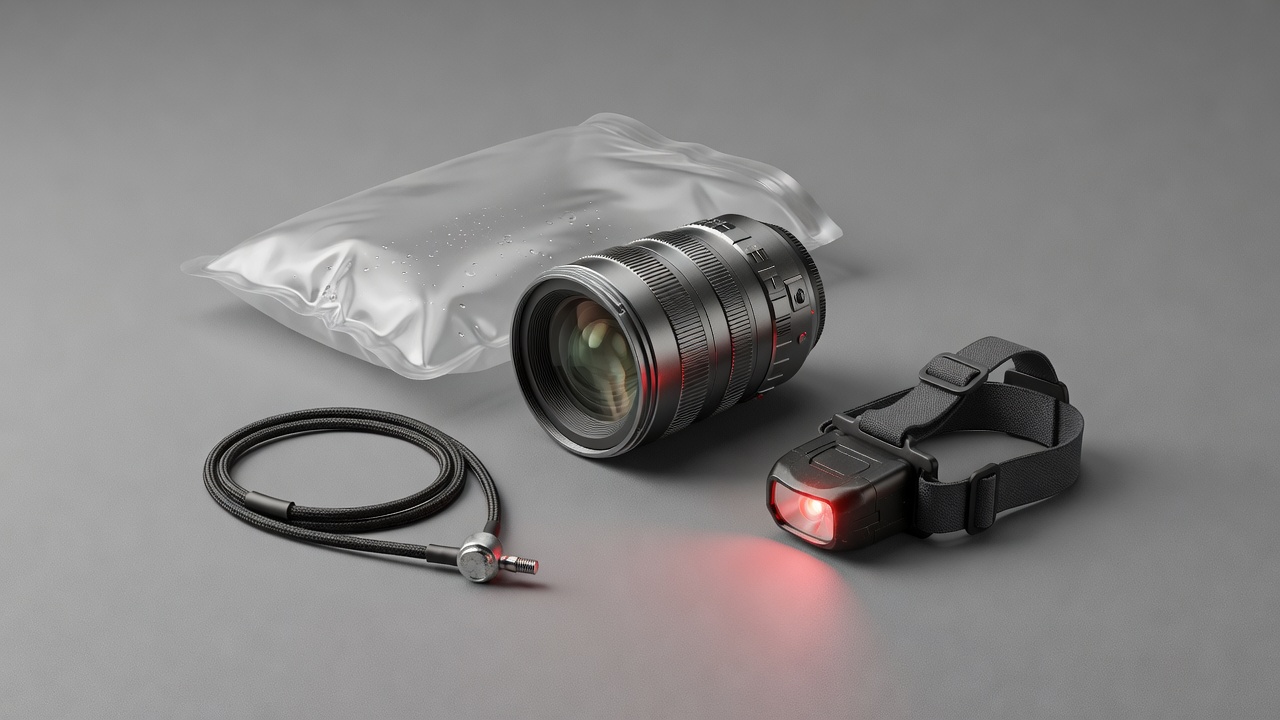
Fumbling with tiny menu buttons in the dark while wearing thick mittens quickly drains the joy from an Arctic evening. The secret to calm winter photography is configuring your camera inside a warm room before you leave: switch to full Manual (M) mode, shoot uncompressed RAW files with white balance locked around 3800K, turn off in-body image stabilization when mounted on a tripod, and assign focus magnification to a single physical button.
Shutter Speed Dictates Curtain Structure
Unlike Milky Way astrophotography—where you always maximize exposure time up to the 500-rule limit—aurora photography requires matching shutter speed to how fast the sky is moving. If a coronal substorm is rippling rapidly overhead, a 15-second exposure smears the vertical pillars into a featureless green wash. Shortening the shutter to 1.5 or 3 seconds freezes the delicate pleated vertical structure.
| Sky Condition & Movement | Shutter Speed | Aperture | ISO Range (Full Frame) | Visual Objective |
|---|---|---|---|---|
| Faint, Slow Horizon Arc (Kp 1–2) | 6 to 10 seconds | f/1.8 – f/2.8 | ISO 1600 – 3200 | Gather subtle photon glow & snow foreground detail |
| Moderate Moving Ribbons | 2.5 to 5 seconds | f/1.4 – f/2.8 | ISO 1600 – 4000 | Preserve curtain edges without clipping bright cores |
| Fast Overhead Corona / Substorm | 0.8 to 2 seconds | f/1.4 – f/2.0 | ISO 3200 – 6400 | Freeze rapid vertical rays and purple/crimson fringes |
| Overcast Polar Twilight (Midday Blue Hour) | 1/30 sec to 2 seconds | f/5.6 – f/8.0 | ISO 100 – 400 | Render deep cobalt snow textures & warm cabin windows |
| Modern Smartphone (Night / Astro Mode) | 3 to 10 sec (Auto-stacked) | Fixed ( ~f/1.8 ) | Auto / Pro RAW 1600 | Must use a rigid phone tripod clamp; disable flash |
Focus, Tripods and Lithium Chemistry
Live-View Star Focusing
Modern mirrorless lenses do not have a hard mechanical stop at true infinity; turning the focus ring all the way to the end usually produces blurry stars. Switch to manual focus, centre a bright star or distant fjord navigation light on your screen, magnify 10x, and turn the ring until the point of light is a tiny pinpoint. Tape the ring in place with gaffer tape.
Carbon Legs & Twist Locks
Bare aluminium tripod legs act as heat sinks that freeze bare fingers on contact; wrap the upper sections in closed-cell foam pipe insulation. Avoid extending the narrow centre column in coastal wind, and press the spiked feet firmly through crusty top snow until they seat into firm pack below.
Rotating Warm Batteries
Cold slows the chemical reaction inside lithium-ion cells, causing your battery meter to drop suddenly to zero even when charge remains. Carry three spare batteries in a zippered shirt pocket next to your body heat; swap the cold cell back into your warm pocket and it will recover much of its usable voltage.
Valuing Foreground and Twilight
Pointing a lens straight up at the zenith rarely conveys a sense of place. Spend thirty minutes during the afternoon twilight scouting balanced foregrounds: a weathered fish-drying rack in Lofoten, dark volcanic boulders framing a tidal lagoon in Iceland, or a single birch tree standing above a frozen lake in Lapland.
Remember to remove screw-on UV or clear protective filters before shooting the northern lights. Excited oxygen emits purest green light at a single monochromatic wavelength (557.7 nm); flat glass filters stacked in front of wide-angle elements reflect that wavelength internally, creating concentric bullseye rings ("Newton's rings") right in the centre of your photograph.
The +1.0 EV Snow Exposure Rule
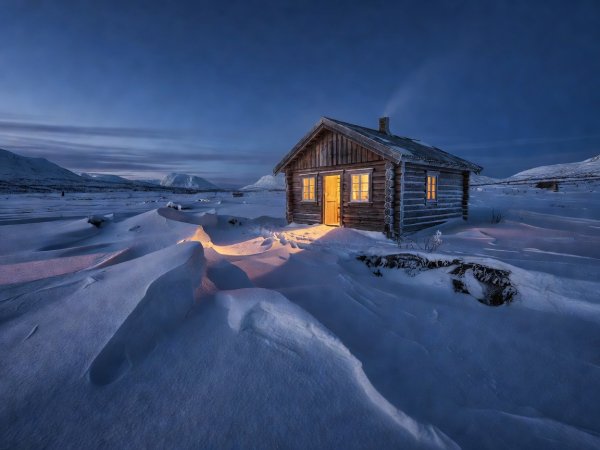
During daytime polar twilight, your camera's light meter tries to turn bright white snow into middle grey, leaving winter scenes murky and underexposed. Dial in +0.7 to +1.3 EV exposure compensation when shooting snow-covered landscapes by day.